
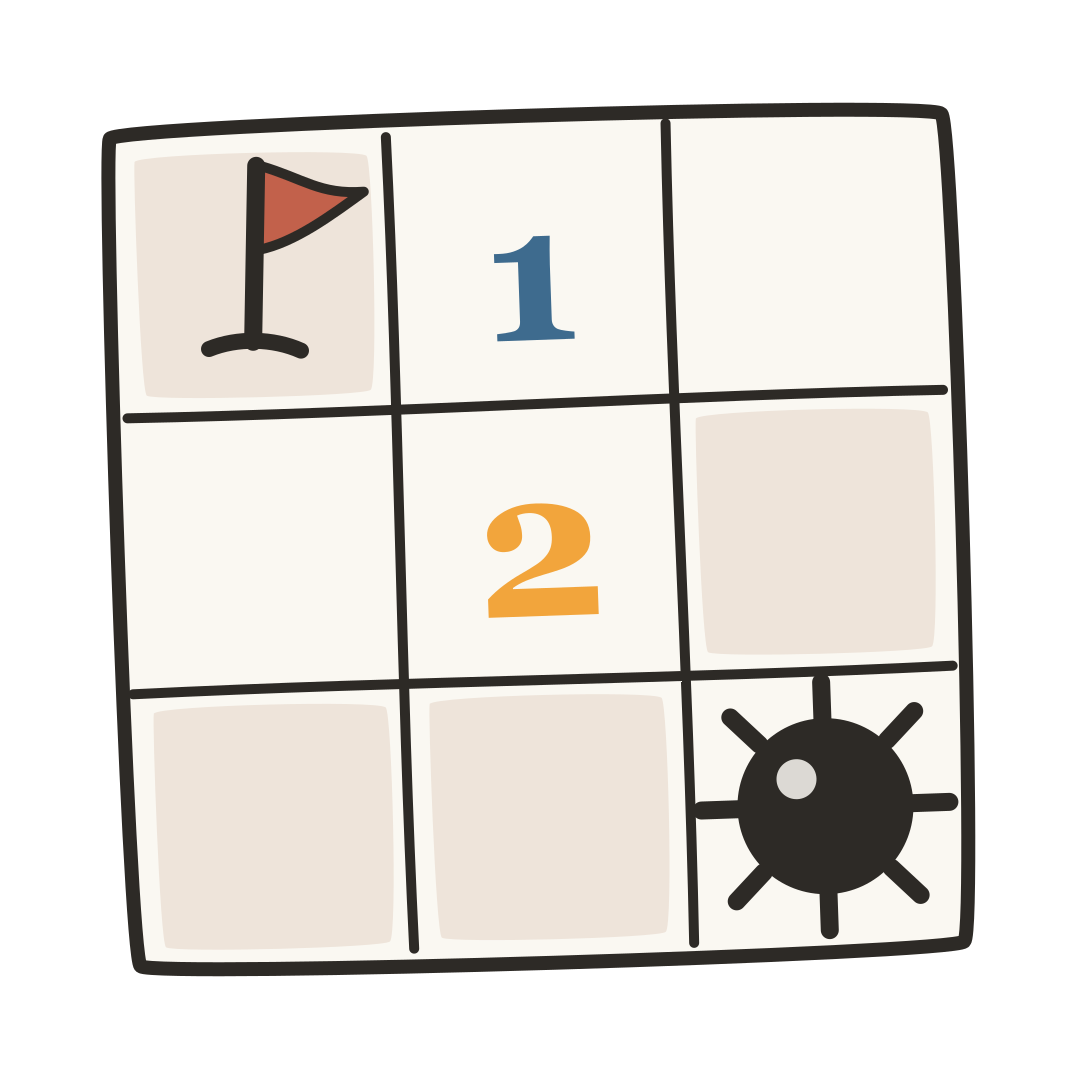
Minesweeper
Every board is solvable without guessing. We check.
Mines are hidden in a grid of cells. Reveal a cell and you get a number, which is how many of its eight neighbors hide a mine. Those numbers are all you need to work out where every mine sits. Flag them, open everything else, and the board is yours.
Every board here is run past a solver before you see it, so a chain of pure deductions always gets you to the win. If you ever feel forced to guess, there's a safer read you haven't spotted yet.
How to play
- Tap a hidden cell to reveal it. A number tells you how many of the eight surrounding cells contain a mine; a blank cell has none, and opens its neighbors automatically.
- Long-press (or right-click) to plant a flag on a suspected mine. Or toggle into Flag mode and every tap becomes a flag.
- Chord to open faster: tap a revealed number that already has the right count of flags around it, and all its remaining neighbors open at once.
- Every board starts with an opening already revealed. That's the shared "first click", and the timer only starts when you make your first move.
- Reveal every safe cell to win. You don't have to flag every mine. Flags are a thinking aid, not a requirement.
- No guessing, ever. Every board is solver-verified, so logic alone is always enough. Hitting a mine means you missed a deduction, not that you got unlucky.
Your stats
Personal records
What is Minesweeper?
A logic puzzle on a grid of hidden cells, some of which conceal mines. Reveal a safe cell and it shows a number: how many mines sit among its eight neighbors. From those numbers alone you can work out which cells must be mines and which must be safe, and clear the field that way. It looks like a game of nerves. Played well, it's a game of deduction, and every click can be justified before you make it.
No guessing, ever
Classic Minesweeper has a dirty secret. Plenty of boards eventually force a 50/50 coin flip, and a good run ends on luck. Not here. Every board on this site, daily and practice alike, is checked by a solver before it reaches you, and only the ones that can be finished with logic alone get served.
So if you're stuck, a forced deduction exists somewhere on the board, and the Hint button will point at one. Losing always means a missed read rather than a bad coin flip. Whether that's comforting is up to you.
One board a day
One board a day, generated from a daily seed so every player faces the same layout: a 16×16 intermediate field with 40 mines. Your first attempt is the one that counts toward your streak, win rate and best-time records. After that the play button keeps dealing fresh solver-verified boards at beginner, intermediate or expert size, as much practice as you want, none of it touching your statistics.
How chording works
Chording is the veteran's speed tool. When a revealed number already has exactly that many flags around it, tapping the number opens every remaining hidden neighbor in one stroke. A tedious cell-by-cell cleanup becomes a single tap.
It's only ever as good as your flags, though. Chord on a misplaced flag and you'll open the mine that flag was supposed to be covering. Flag carefully, then chord boldly.
Strategy: the 1-2-1 pattern
Some number arrangements solve themselves once you learn to see them. The famous one is 1-2-1 along a straight edge: the mines must sit next to the two 1s, and the cell facing the 2 is always safe. Its cousin 1-2-2-1 puts both mines under the 2s and makes both cells facing the 1s safe. Corners are friendly too, since a 1 in a corner touching a single hidden cell is a guaranteed mine.
Collect enough of these and whole sections of a board stop being puzzles and start reading like sentences.
A brief history
Grid-based mine games go back to 1960s mainframes, but Minesweeper became a household name when Microsoft shipped it with Windows 3.1 in 1992, two years after it first appeared in the Windows Entertainment Pack. It was there partly to teach a generation precise mouse control, and it quietly turned into one of the most-played computer games in history. Decades of competitive play followed, and eventually the "no guess" movement this site belongs to: keep the deduction, drop the luck.