
FreeCell
Four free cells, eight cascades, and every deal can be won.
A single 52-card deck, dealt face-up into eight cascades. The four free cells are parking spots for unblocking cards. Build the cascades down in alternating colors and move every card home to the four foundations, Ace to King. Nothing is hidden, which makes this unlike most solitaire games, and with careful planning every daily deal here can be won.
How to play
- All 52 cards are dealt face-up into eight cascades: four columns of seven cards and four of six.
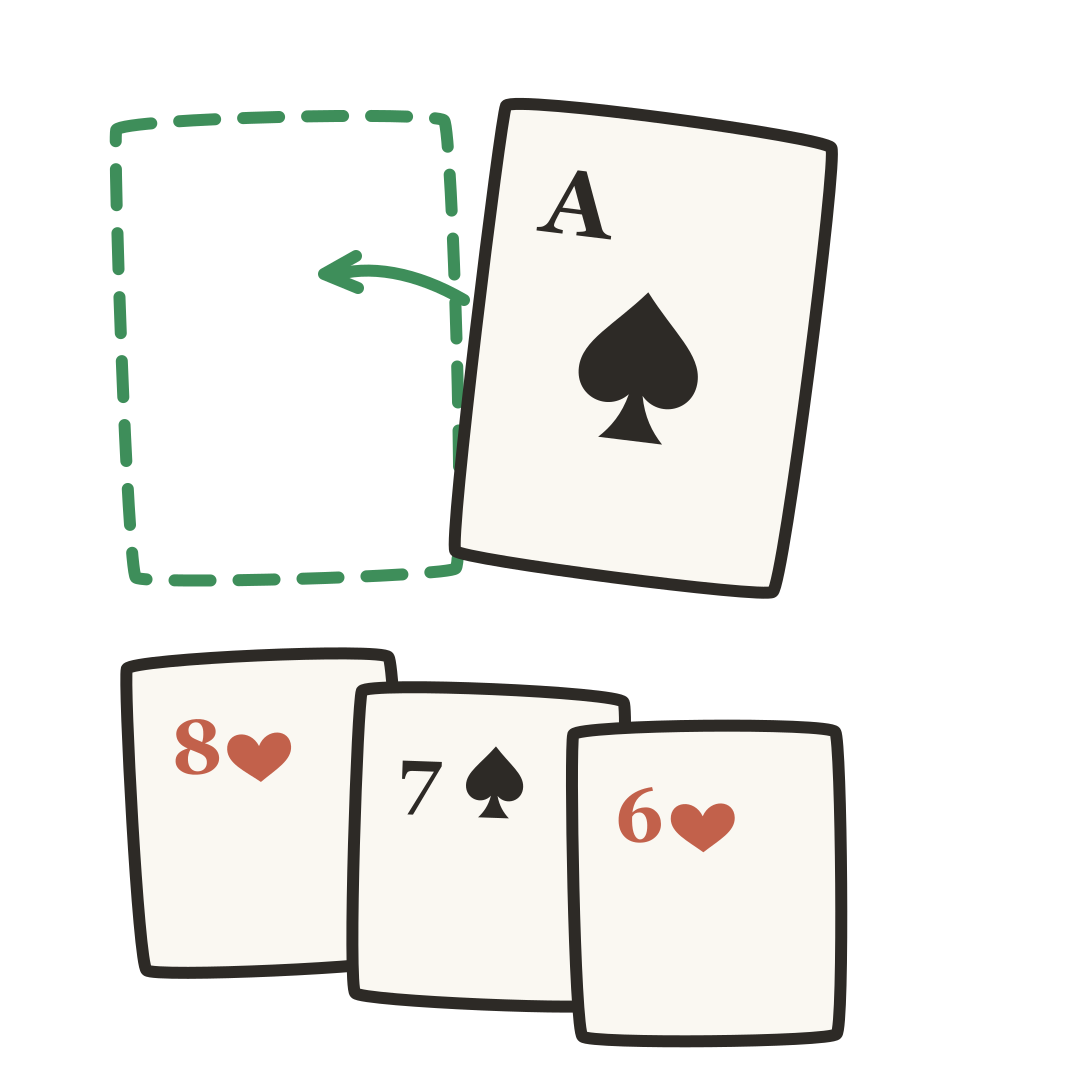
- Build cascades downward in alternating colors (e.g. a red 7 on a black 8). Any card can go on an empty cascade.
- Park any single card in one of the four free cells, one card per cell, to unblock whatever is underneath it.
- Build the four foundations up by suit, from Ace to King. Move all 52 cards home to win.
- Move ordered runs together as a supermove. Capacity is (1 + empty free cells) × 2 per empty cascade.
- Undo is unlimited, but every undo costs a move.
Your stats
Personal records
What is FreeCell?
A solitaire card game played with a single standard deck. The defining feature is right there in the name: four "free" cells, each able to hold one card while you rearrange the tableau. And because every card is dealt face-up from the start, FreeCell is planning rather than luck. You can see the whole problem before you make your first move.
Every deal is solvable
Nearly all FreeCell deals can be won, which is rare among solitaire games. We go one step further and run a solver over every daily deal before publishing it, so when you sit down you know a winning line exists. If you get stuck, it isn't the cards' fault. Undo, rethink, try a different order.
One deal a day
One new deal a day, generated from a seed, so everyone who visits that day faces the same solver-verified layout. Your first game against it is the one that counts toward your streak, best time and fewest-moves records. After that the play button just keeps dealing: fresh random shuffles, as many as you want, none of them touching your statistics.
FreeCell ranks by time, and hints price into it gently: each hint you take adds five seconds to your leaderboard time for the day. Your own best-time record stays the raw clock, so you always know what you actually played.
Supermoves explained
Officially FreeCell only lets you move one card at a time. Moving a run is really a sequence of single moves shuttled through free cells and empty cascades, and that's what a "supermove" is.
The number you can move at once is (1 + empty free cells) × 2 for each empty cascade. With all four cells free you can move five cards. Add one empty cascade and that doubles to ten. The game does the bookkeeping for you, but the capacity rule is still the rule, so keep cells and columns clear when you know a long run needs relocating.
Strategy tips
Free your Aces and 2s early. They're usually buried mid-cascade and everything else depends on them. Treat the free cells as a loan rather than storage: a card parked in a cell has to come out eventually, and four full cells cuts you down to single-card moves.
Empty a whole cascade whenever you can, because an empty column is the most powerful resource in the game. And plan several moves ahead before you touch anything. All the cards are visible, so the win is decided by the order of your moves, not by the deal.
A brief history
Paul Alfille invented FreeCell in 1978 and programmed the first computer version on the PLATO educational system, building on older games like Eight Off. It went worldwide once Microsoft bundled it with Windows 95, and its "every deal can be won" reputation turned solving all 32,000 original numbered deals into a community quest. It's still one of the most-played skill-based solitaire games anywhere.